NYT vs. AI Giants: How the 2026 Verdict Changes Content Ownership Forever
 By
Editor Team
By
Editor Team
The Best Attorney USA Editorial Team is dedicated to bringing transparency and clarity to the American legal landscape. Composed of legal researchers,...
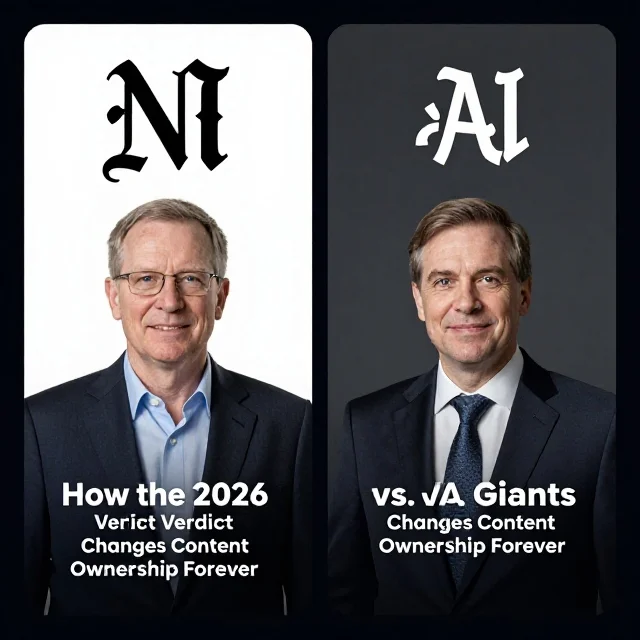
The world of digital media changed forever in early 2026. After years of legal battles, the court finally reached a pivotal decision in the consolidated case of NYT vs AI Giants Verdict 2026. This wasn't just a fight between two companies; it was a battle over who owns the words we read online. For decades, publishers relied on copyright law to protect their stories. But as artificial intelligence (AI) began "reading" millions of articles to learn how to speak, the old rules started to break.
The 2026 verdict has set a new standard for intellectual property rights for publishers 2026. It balances the need for AI companies to innovate with the right of creators to be paid for their work. In this new era, "Fair Use" has been redefined, and the relationship between human writers and machine learning has been legally cemented.
The Legal Titans: 10 Lawyers Shaping the AI Era
Navigating the complex discovery phase which involved the review of over 20 million anonymized ChatGPT logs required the sharpest legal minds. These ten lawyers are the top-tier experts currently defining how content ownership works in the age of automation.
Ian C. Ballon (Greenberg Traurig)
Expertise: Internet Law and Intellectual Property.
Why Top-Tier: Known for his massive multi-volume treatise on internet law, Ballon is the go-to expert for complex digital copyright disputes. He understands the technical "plumbing" of AI better than almost anyone.
Sharon R. Flanagan (Sidley Austin)
Expertise: AI Governance and Emerging Tech.
Why Top-Tier: Flanagan leads Sidley’s global AI team. She is a pioneer in helping companies navigate the "data crisis" that occurs when AI training hits privacy regulations.
Annette Hurst (Orrick)
Expertise: Software Copyright and Generative AI.
Why Top-Tier: Hurst has been a leading voice in "transformative use" cases. She is often credited with anticipating the exact legal hurdles AI companies would face with "output log" data.
Andrew Gass (Latham & Watkins)
Expertise: Copyright and Antitrust.
Why Top-Tier: Gass represents many of the tech giants. He is famous for arguing that AI training is a "non-expressive" use of data a key argument in the 2026 verdict.
Joseph Gratz (Morrison Foerster)
Expertise: Tech Litigation.
Why Top-Tier: Gratz was a key player in the Google Books case, which paved the way for modern AI training legalities. He is a master at explaining complex code to judges.
Kalpana Srinivasan (Susman Godfrey)
Expertise: High-Stakes Commercial Litigation.
Why Top-Tier: Representing the NYT, Srinivasan and her team are experts at proving "market harm." They successfully argued that AI-generated news summaries could replace the original source.
Bill Lee (WilmerHale)
Expertise: IP Litigation.
Why Top-Tier: A veteran of the "Smartphone Wars," Lee brings decades of experience in high-stakes tech trials. His ability to handle "discovery" disputes like the destruction of training data is legendary.
Dale Cendali (Kirkland & Ellis)
Expertise: Intellectual Property.
Why Top-Tier: Cendali is a powerhouse in media defense. She has protected the biggest brands in the world from unauthorized digital replication, making her essential for publishers in 2026.
Mark Brennan (Hogan Lovells)
Expertise: Global Regulatory and AI Compliance.
Why Top-Tier: As AI laws become global, Brennan helps companies harmonize their data use across US and EU borders, specifically regarding "machine-readable" copyright tags.
Christine Yiu (Bird & Bird)
Expertise: Cross-Border IP.
Why Top-Tier: Yiu specializes in the Asia-Pacific market, which is crucial as AI firms look for "safe havens" for data training outside of US jurisdiction.
Deep Dive: The Verdict and Its Impact
The core of the NYT vs AI Giants Verdict 2026 centered on one question: Is it "Fair Use" for an AI to learn from a copyrighted article without paying for it?
The court ruled that while AI training is generally transformative, the specific output of an AI matters. If a chatbot "regurgitates" a news story nearly verbatim, it is no longer fair use it is infringement. This has led to the "Licensing Revolution." In 2026, major publishers no longer just sue AI companies; they sign massive data-sharing deals.
Key Outcomes for Publishers:
Mandatory Transparency: AI companies must now provide "machine-readable" logs showing what data was used to generate a specific answer.
The End of "Prompt Hacking": The court clarified that users cannot intentionally "trick" an AI into breaking copyright just to sue the AI company.
Data Preservation Orders: In a landmark move, courts now require AI giants to preserve "output log data." This ensures that if an AI steals content, the evidence isn't "deleted" by the system's training cycle.
Frequently Asked Questions
Need Legal Assistance?
Our experienced attorneys are ready to help you with your legal matters. Get personalized consultation today.
Get ConsultationRecent Posts
5 Defining Civil Litigation Cases of 2026: How Leaders Must Adapt to AI, Trade
Jun 21, 2026
5 Defining Civil Litigation Cases of 2026: How Leaders Must Adapt to AI, Trade, and Regulatory Shifts
Feb 23, 2026

Top 10 Best Personal Injury Attorneys in Los Angeles, CA (2026)
Feb 22, 2026
The 2026 USA Visa Outlook: Key Changes to H-1B, Green Cards, and Work Authorization
Feb 08, 2026
Divorce in the Digital Age: How to Protect (and Split) Crypto, NFTs, and Digital Businesses
Feb 08, 2026